Cocobi Life World - city, town
- 3.9
- Rating
- 10.00M
- Installs
- Free
- Price

 Analysis by App-foxy
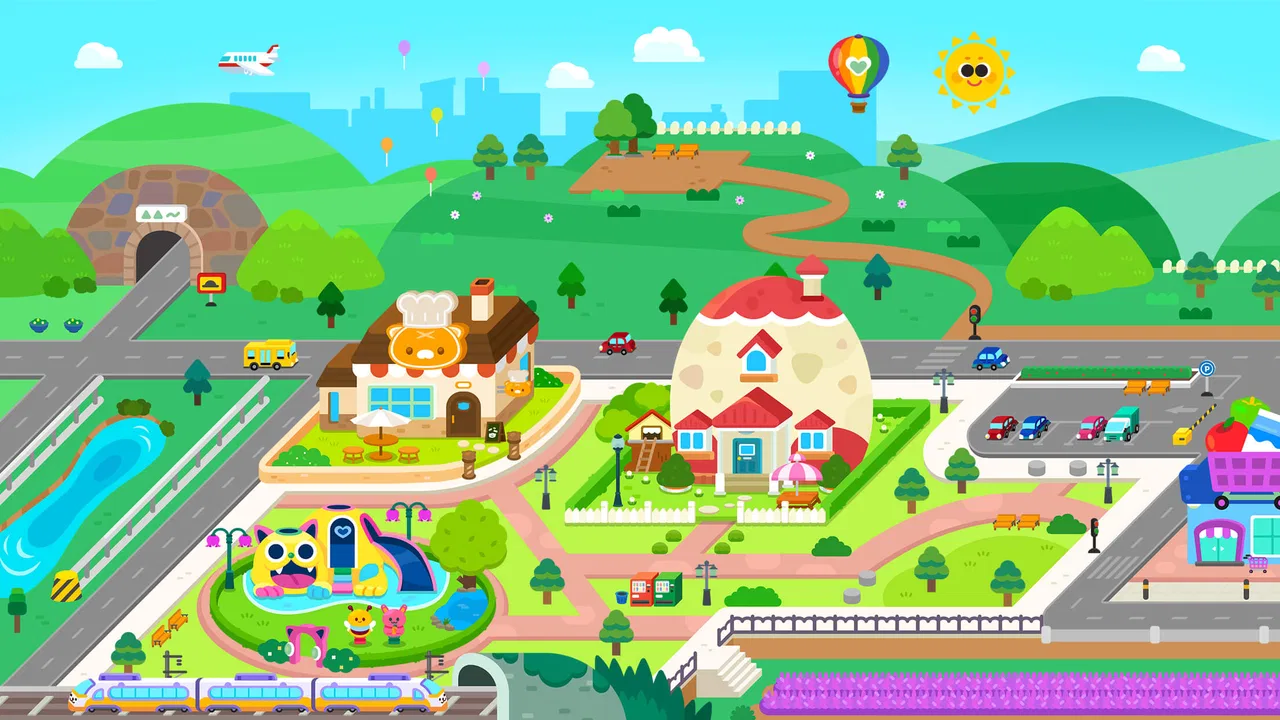
My first impression of Cocobi Life World was that it understands a child’s attraction to small, friendly worlds better than many educational games do. Instead of presenting learning as a worksheet with bright colors added afterward, it puts Cocobi’s little dinosaurs into a city-and-town setting where children can explore, arrange situations, and create their own simple stories. That makes the first few sessions feel easy to enter: there is no complicated rulebook to study before play can begin.
This is a free educational game from KIGLE for children, with an Everyone age rating. It runs on Android 7.1 or later, and the current version is 1.1.4. The basic idea is straightforward, but the important question is whether that open-ended appeal survives once the novelty of meeting the characters and discovering the town has faded. In my experience, it can remain useful as a short, repeatable play space, although it is not the right choice for every child or every parent.
From an exciting first week to a more familiar routine
I find the shift from the first burst of discovery to an ordinary play routine is where this game’s fit becomes clearer. This section looks at how a parent can notice whether the child is still making choices and stories, rather than relying on the characters’ initial appeal. That distinction leads naturally to what can keep the experience worthwhile once everything feels familiar.
You May Also Like

 Blood Strike: 2.5 Anniversary
Blood Strike’s Loadouts Turn Every Drop Into a Tactical Gamble
A close look at Blood Strike’s custom loadouts: how fast access to signature weapons reshapes its battle royale rhythm, rewards preparation, and narrows the gap between fights.

 Pandora - Music & Podcasts
Pandora’s Music Is Easy to Start, but Harder to Recover
Pandora’s strength is its low-effort path from a seed to a station. Its weak spot is how much confidence it asks you to place in connection, setup, and quiet recovery.

 8 Ball Pool
 Is Built on Rivalries, Rematches, and Routine
A close look at the rivalries, rematches, shared routines, and unanswered safety questions that turn a quick pool match into a persistent mobile community.

 Samsung Music
’s Quiet Strength Is Playing What You Already Own
Its reach comes less from spectacle than from dependable access to a personal library. That simplicity is both the app’s strongest retention engine and its ceiling.

 AccuWeather: Weather Radar
AccuWeather Review: A Quick, Clear Forecast for Everyday Decisions
For everyday plans, the best forecast is the one you can understand quickly. AccuWeather makes rain timing, radar, and local conditions easy to act on, with a few trade-offs.

 Hill Climb Racing
Why Hill Climb Racing Still Turns Crashes Into One More Run
A tiny car, a bumpy hill and one more upgrade: Hill Climb Racing keeps resurfacing because its simple chaos makes every near-miss feel personal.
More From Our News Desk



Why the opening sessions work
During the first week, the strongest part is the freedom to explore without making the child feel tested. A young player can move through the life-world setting, notice the characters, and experiment with ordinary situations at their own pace. That matters for children who become frustrated when a game immediately demands correct answers, fast reactions, or careful reading.
I also like the way the city-and-town theme gives play a recognizable frame. Children already understand the appeal of shops, homes, streets, and everyday activities from real life or from other pretend games. Cocobi turns those familiar ideas into a playful setting without requiring the child to understand a complicated fictional universe first. The result is a gentler starting point than many action-focused children’s games.
The educational value is most convincing when an adult treats the game as a prompt rather than a complete lesson. A parent can ask the child what a character is doing, why a place might be useful, or what should happen next in an invented story. Those conversations add language practice, sequencing, and social imagination without making the session feel like formal homework.
One useful first-week routine is to let the child lead for a few minutes, then ask for a short explanation of the scene they created. This reveals whether the game is encouraging active imagination or merely producing repeated taps. It also gives parents a practical way to judge engagement without interrupting every moment with questions.
What makes it suitable for younger players
The tone is approachable, and the dinosaur characters give the world an immediate personality. Children who enjoy role-play may get more from it than children who want a clearly defined challenge with levels, scores, or a finish line. The lack of pressure is a strength for relaxed play, especially after school or before a quiet bedtime routine.
Because the game is free to start, it is also relatively easy to try without committing money first. That does not mean the experience is completely cost-free: in-app purchases range from $2.20 to $2.90 per item. I would set expectations with a child before handing over the device, particularly if the child is accustomed to asking for every visible option in a game.
The Everyone rating makes the intended audience clear, but an age label cannot replace supervision. Younger children may still need help understanding what can be selected, what is part of the pretend world, and which purchase prompts should be ignored. I would introduce it on a shared device before allowing independent play.
The first-week test I would use
After several sessions, I would look for three signs of real interest. First, does the child return to create a different situation rather than repeat the same action? Second, can they describe what happened in their own words? Third, do they voluntarily connect the game with real-life ideas, such as talking about a place in town or inventing a role for one of the dinosaurs?
If the answer is yes, the game is doing more than filling time. If the child only taps through the same interactions and quickly asks for another application, the attractive presentation may be carrying the experience more than the underlying replay value. That distinction becomes important after the first week.
What remains useful after the novelty fades
When the town no longer feels new, I think the most useful test is whether a child can bring a fresh purpose to a familiar scene. Here I focus on small ways to connect play with conversation and everyday observations, so the game has a role beyond simply occupying a screen. That raises the practical question of how much adult involvement and spending the routine may require.
Month-to-month value depends on open-ended play
This is not a game I would choose for measurable progress. It is better understood as a digital pretend-play space with educational possibilities. The recurring value comes from changing the child’s story, not from climbing a visible ladder of achievements. A child might use the same town in a new way by assigning different roles, changing the order of events, or explaining a scene from another character’s point of view.
That gives it a different rhythm from educational apps built around spelling drills, counting exercises, or fixed puzzles. Those alternatives are usually better when a parent wants a specific skill practiced repeatedly and clearly. Cocobi is more suitable when the goal is to encourage speaking, imagination, observation, and simple storytelling through play.
For a realistic everyday use case, I can see a parent using it during a short waiting period: a child has finished a snack, an appointment is running late, or a sibling needs attention. The parent could invite the child to create one small town story and then retell it aloud. That makes the session more purposeful than simply handing over a device, while still preserving the child’s control over the activity.
Another useful approach is to connect the game with a real outing. Before visiting a shop, park, or public building, a parent could ask the child to imagine what people do there in the Cocobi world. Afterward, the child can compare the imagined version with reality. This is a modest activity, but it turns the game into a bridge between screen play and observation rather than a sealed-off distraction.
Who is likely to keep returning
The strongest long-term audience is children who naturally make up stories with toys, figures, or drawings. They may not need a new objective every time because the pleasure comes from arranging a situation and seeing where it leads. The game can also work well for siblings or a parent and child who enjoy taking turns deciding what happens next.
Children who prefer clear goals may be less satisfied. If a player expects races, puzzles with answers, character upgrades, or a strong sense of completion, the open-ended structure may feel empty after the first burst of discovery. In that case, a more structured educational title would probably earn more regular use.
I would also be cautious about calling it a complete learning solution. It can support conversation and pretend play, but it should sit alongside books, physical toys, creative activities, and direct interaction. Its value is strongest when it adds a setting for those habits rather than replacing them.
How it compares with familiar alternatives
Compared with a traditional puzzle-based learning game, Cocobi offers less obvious measurement and more room for personal interpretation. A puzzle app can show whether an answer is correct; this game is more likely to show how a child thinks about people, places, and events. That makes it less useful for targeted practice but more inviting for imaginative play.
Compared with open-ended toy play, it provides a ready-made world and characters, which can help a child who does not know how to begin a pretend scenario. The trade-off is that the child is working inside the choices and presentation supplied by the game. Physical toys, paper, and drawing usually offer fewer built-in prompts but can be more flexible once the child starts inventing.
Compared with short-form video, the game asks for more participation. The child has to choose actions and construct meaning instead of only watching. Still, parents should not assume that every tap is educational. The quality of the session depends on whether the child is making decisions, explaining ideas, and varying the play.
Maintenance, fatigue, and the cost of keeping it useful
I see long-term usefulness as a balance between the child’s own imagination and a parent’s light-touch guidance. This section considers the signs that repetition is setting in, how to make stopping and purchase boundaries less fraught, and when another activity may be a better fit. Those trade-offs lead into a broader judgment about whether the game deserves a regular place in family life.
The maintenance burden is mostly adult guidance
The game itself is easy to revisit, but keeping it valuable requires a little planning. Without occasional prompts, a child may settle into a narrow pattern and repeat the most familiar interactions. I would rotate the purpose of each session: one day could focus on describing a place, another on inventing a story, and another on noticing how characters might help one another.
This does not need to become a lesson plan. A single question is often enough: “What happens next?”, “Who could help here?”, or “Can you tell me the story from the dinosaur’s point of view?” Those questions preserve the game’s relaxed mood while encouraging language and reasoning.
Parents should also decide how the game fits into the household’s device rules. Since the experience is designed for children and includes in-app purchases, I would check the device’s purchase controls and explain that free access does not mean every option is automatically available. That conversation is more useful before the child encounters a locked or tempting item.
Another practical habit is to watch the child play occasionally rather than relying on the game’s bright presentation. If the child is calm, creative, and able to stop when asked, the game is probably fitting well into the routine. If play becomes repetitive, argumentative, or focused mainly on obtaining more content, the parent may need to shorten sessions or move to a different activity.
Where repetition begins to show
The main source of fatigue is the tension between a familiar world and limited novelty. A town setting can support many stories, but the child still encounters the same overall cast and environment. Once the discovery phase is over, the game needs the player’s imagination to supply the variety.
That is a reasonable design choice, but it means the game’s staying power differs sharply from child to child. A creative child may keep finding new combinations, while another may decide that the same scenes feel finished. I would not judge the game harshly for this, but I would avoid expecting it to provide endless new stimulation on its own.
There can also be a gap between a parent’s expectation of “educational” and what the game actually offers. If you want direct instruction, repeated practice, or a clear learning record, this is not the most efficient tool. Its educational side is indirect and conversational, which is valuable but harder to measure.
Purchase prompts and shared-device friction
The free entry point is helpful, but the presence of paid items introduces a small management task. With individual purchases priced between $2.20 and $2.90, a child may see extra content as a natural extension of play rather than a financial decision. I would make the rule simple: the child can explore the free experience, and any purchase requires an adult’s permission.
Shared devices create another possible inconvenience. A child may want uninterrupted control, while a parent may need the phone or tablet for other tasks. The best arrangement is to use the game during a defined window and end with a natural stopping point, such as finishing one invented story. That is easier than removing the device suddenly in the middle of an activity.
Families should also remember that the game requires Android 7.1 or later on Android devices. For most relatively modern phones and tablets this should not be a major obstacle, but it is worth checking before planning around it. The iOS or Android experience may also feel different depending on the device’s screen size and responsiveness, so I would test it on the device the child will actually use.
Signs that it is time to move on
I would consider reducing use if the child stops inventing anything, becomes focused only on unlocking paid options, or treats the game as background tapping. I would also move to a different app when a specific learning goal becomes more important than free exploration. For example, a structured reading or number practice tool will usually be a better match when the parent wants a repeatable exercise with a clear answer.
That does not make Cocobi a failure. It simply reflects its role. It is a flexible play environment, not a universal replacement for every educational activity. Knowing that boundary prevents disappointment and helps the game remain enjoyable instead of being pushed into a job it was not designed to do.
My long-term verdict for families
KIGLE has made a gentle city-and-town game that is easy for children to approach and easy for adults to understand. Its strongest quality is not a complicated system but the way it gives young players a friendly setting for pretend play. The dinosaurs provide a recognizable anchor, while the everyday world gives children enough context to invent scenes and talk about them.
The game has reached over ten million installs, and its average rating is 3.9 from around 7.2 thousand ratings. Those figures suggest broad interest alongside a mixed experience, which matches my view: the concept is appealing, but its lasting value depends heavily on the child’s play style and the adult’s expectations.
I would recommend it to parents looking for a free starting point for imaginative, screen-based play, especially when they are willing to join in with a question or two. It is a good candidate for short sessions, travel, waiting rooms, and calm creative time. The Everyone rating also makes it an approachable option for families seeking a child-friendly setting, though supervision around device use and purchases still makes sense.
I would skip it if your priority is a tightly structured curriculum, visible skill tracking, or constant new challenges. I would also hesitate for a child who quickly loses interest in open-ended role-play. In those cases, a focused educational game, a physical activity, or a storybook may provide more dependable month-to-month value.
My final judgment is that the game earns a place as an occasional creative activity, not as a complete learning routine. Its first-week appeal is immediate, and it can remain useful after that point when the child supplies new stories and the parent keeps the sessions purposeful. Without that small amount of guidance, repetition and purchase-related friction can make the experience feel thinner over time.
For families comfortable with that trade-off, the free entry makes trying it sensible. I would begin with a shared session, set clear purchase boundaries, and watch whether the child creates something new rather than simply revisiting the same actions. If the answer stays positive, Cocobi Life World can become a pleasant part of a broader play routine. If not, moving to a more structured alternative is the honest choice.
FAQs for Cocobi Life World - city, town
01What is Cocobi Life World and how does it work?
Cocobi Life World is an interactive simulation game where players can explore a vibrant city and town environment. It allows users to create and customize characters, build their own stories, and interact with a variety of elements within the game. The app provides a sandbox experience, encouraging creativity and exploration.
02Is Cocobi Life World suitable for children?
Yes, Cocobi Life World is designed to be child-friendly, offering a safe and engaging environment for younger players. It focuses on creativity and discovery, with no inappropriate content. Parents can feel comfortable letting their children explore and learn within the app, thanks to its intuitive and educational design.
03How can I customize my characters in Cocobi Life World?
The game offers extensive character customization options. Users can choose from a wide range of hairstyles, clothing, and accessories to create unique avatars. The customization is user-friendly, allowing both children and adults to easily design characters that reflect their personal style or imagination.
04Does Cocobi Life World require an internet connection?
Cocobi Life World can be played offline, which is great for users who want to enjoy the game on the go without needing a constant internet connection. However, some features, such as downloading new content or updates, may require an internet connection to access the latest additions.
05Are there in-app purchases in Cocobi Life World?
Yes, Cocobi Life World includes in-app purchases that allow players to access additional content and features. While the game is free to download, these optional purchases can enhance the experience by unlocking new areas, items, or customization options. Parents should be aware and manage purchase settings accordingly.
Pros
- Diverse cityscapes to explore and interact with.
- Engaging mini-games enhance learning and fun.
- User-friendly interface for all age groups.
- Regular updates with new content and features.
- Offline mode available for uninterrupted play.
Cons
- In-app purchases can become costly.
- Limited customization options for characters.
- Occasional lag on older devices.
- Requires significant storage space.
- Ads may interrupt gameplay.

Cocobi Life World - city, town
Gallery